
|
|
A brief explanation about our site.
We are a family of many generations of Celtic heritage. Our family roots come from Ireland The first addition of grandchildren to our family was a daughter The latest additions to our family have been all boys- |

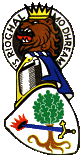
| Gaelic Name: Motto: Badge: Lands: Origin of Name: Pipe Music: |
MacGrioghair ‘S rioghal mo dhream (My race is royal) Pine Argyll and Perthshire Son of Gregory (Flocksman) Ruaig Ghlinne Freoine (Chase of Glen Fruin) |
| Arms: Argent, a sword in bend dexter Azure and an oak tree eradicated in bend sinister Proper, the former supporting on its point in dexter canton an antique crown Gules.
Definition of the word Clan: |
The MacGregor’s motto “My blood is royal” is their claim to royal descent.
|
 |
|
|
|
|
|
|
|
|
|
|||||||
 |
 |
|||||||||||||||
|
||||||||||||||||
|
||||||||||||||||
| Claiming a regal origin, their motto anciently
was, "My race is royal". Griogar, said to have been the third son of Alpin, king
of Scotland, who commenced his reign in 833, is mentioned as their remote ancestor, but it
is impossible to trace their descent from any such personage, or from his eldest brother,
Kenneth Macalpine, from whom they also claim to be sprung. According to Buchanan of Auchmar, the clan Gregor were located in Glenorchy as early as the reign of Malcolm Canmore (1057-1093). As, however, they were in the reign of Alexander II, (1214-1249) vassals of the Earl of Ross, Skene thinks it probable that Glenorchy was given to them, when that monarch conferred a large extent of territory on that potent noble. Hugh of Glenorchy appears to have been the first of their chiefs who was so styled. Malcolm, the chief of the clan in the days of Bruce, fought bravely on the national side at the battle of Bannockburn. He accompanied Edward Bruce to Ireland, and being severely wounded at Dundalk, he was ever afterwards know as "the lame lord". |
| In the reign of David II, the Campbells managed to procure
a legal title to the lands of Glenorchy; nevertheless, the Macgregors maintained, for a
long time, the actual possession of them by the strong hand. They knew no other right than
that of the sword, but ultimately that was found unavailing, and at last, expelled from
their own territory they became an outlawed, lawless and landless clan. John Macgregor of Glenorchy, who died in 1390, is said to have had three sons; Patrick, his successor’ John Dow, ancestor of the family of Glenstrae, who became the chief of the clan; and Greogor, ancestor of the Macgregors of Roro. Patrick’s son, Malcolm, was compelled by the Campbells to sell the lands of Auchinrevach in Strathfillan to Campbell of Glenorchy, who thus obtained the first footing in Breadalbane, which afterwards gave the title of earl to his family. The principle families of the Macgregors, in process of time, except that of Glenstrae, who held that estate as vassals of the Earl of Argyll, found themselves reduced to the position of tenants on the lands of Campbell of Glenorchy and other powerful barons. It being the policy of the latter to get rid of them altogether, the unfortunate clan was driven, by a continuous system of oppression and annoyance, to acts of rapine and violence, which brought upon them the vengeance of the government. The clan had no other means of subsistence than the plunder of their neighbours’ property, and as they naturally directed their attacks chiefly against those who had wrested from them their own lands, it became still more the interest of their oppressors to represent to the king that nothing could put a stop to their lawless conduct, "save the cutting off the tribe of Macgregor root and branch". In 1488, soon after the youthful James IV had ascended the throne which the murder of his father had rendered vacant, an act was passed "for staunching of thiftreif and other enormities throw all the realme"; evidently designed against the Macgregors, for among the barons to whom power was given for enforcing it, were Duncan Campbell of Glenorchy, Neil Stewart of Fortingall, and Ewin Campbell of Strachur. At this time the Macgregors were still a numerous clan. Besides those in Glenorchy, they were settled in great numbers in the districts of Breadalbane and Athol, and they all acknowledged Macgregor of Glenstrae, who bore the title of captain of the clan, as their chief. With the view of reducing these branches Sir Duncan Campbell of Glenorchy obtained in 1492, the office of bailiary of the crown lands of Disher and Toyer, Glenlyon, and Glendochart, and in 1502 he procured a charter of the lands of Glenlyon. "From this period", says Mr Skene, "the history of the Macgregors consists of a mere list of acts of privy council, by which commissions are granted to pursue the clan with fire and sword, and of various atrocities which a state of desperation, the natural result of these measures, as well as a deep spirit of vengeance, against both the farmers and executors of them, frequently led the clan to commit. These actions led to the enactment of still severer laws, and at length to the complete proscription of the clan"" But still the Macgregors were not subdued. Taking refuge in their mountain fastness, they set at defiance all the efforts made by their enemies for their entire extermination, and inflicted upon some of them a terrible vengeance. In 1589 they seized and murdered John Drummond of Drummond Ernoch, a forester of the royal forest of Glenartney, an act which forms the foundation of the incident detailed in Sir Walter Scott’s "Legend of Montrose". The clan swore upon the head of the victim that they would avow and defend the deed in common. An outrage like this led at once to the most rigorous proceedings on the part of the crown. Fresh letters of fire and sword for three years were issued against the whole clan, and all persons were interdicted from harbouring or having any communication with them. Then followed the conflict of Glenfruin in 1603, when the Macgregors, under Alexander Macgregor of Glenstrae, their chief, defeated the Colquhouns, under the laird of Luss, and 140 of the latter were killed. (Details of this celebrated clan battle can be read in the Clan Colquhoun pages). Duglad Ciar Mohr, ancestor of Rob Roy, is said on this occasion to have exhibited extraordinary ferocity and courage. In relation to the betrayal and melancholy end of the unfortunate chief, Alexander, Macgregor of Glenstrae, there is the following entry in the MS diary of Robert Birrell: "The 2 of October (1603) Allester M’Gregour Glainstre tane be the laird of Arkynles, bot escapit againe; but efter, taken be the Earle of Argyill the 4 of Januar; and brocht to Edinburghe the 9 of Januar 1604, with mae of 18 his friendis, M’Gregouris. He was convoyit to Berwick be the gaird, conforme to the earlis promese; for he promesit to put him out or Scttis grund/ Swa he keipit ane Hieland-manis promes; in respect he send the gaird to convoy him out of Scottis grund. But thai wer not directit to pairt with him back agane! The 18 of Januar, at evine, he come agane to Edinburghe; and upone the 20 day, he was hangit at the croce, and ij (eleven) of his freindis and name, upone ane gallows: Himselff, being chieff, he was hangit his awin hicht above the rest of his friendis". That Argyll had an interest in his death appears from a declaration, printed in Pitcairn’s Criminal Trials, which the chief made before his execution, wherein he says that the earl had enticed him to commit several slaughters and disorders, and had endeavoured to prevail upon him to commit "sundrie mair". Among other severe measures passed against this doomed clan was one which deprived them of their very name. By an act of the privy council, dated 3d April 1603, all of the name of Macgregor were compelled, on pain of death, to adopt another surname, and all who had been engaged at the battle of Glenfruin, and other marauding expeditions detailed in the act, were prohibited, also under pain of death, from carrying any weapon but a knife without a point to cut their victuals. They were also forbidden, under the same penalty of death, to meet in greater numbers that four at a time. The Earls of Argyll and Athole were charged with the execution of these enactments, and it has been shown how the former carried out the task assigned to him. With regard to the ill-fated chief so trechously "done to death" by him, the following interesting tradition is related: His son, while out hunting one day, met the young laird of Lamond travelling with a servant from Cowal towards Inverlochy. They dined together at a house on the Blackmount, between Tyndrum and King’s House, but having unfortunately quarrelled during the evening, dirks were drawn, and the young Macgregor was killed. Lamond instantly fled, and was closely pursued by some of the clan Gregor. Outstripping his foes, he reached the house of the chief of Glenstrae, whom he besought earnestly, without stating his crime, to afford him protection. "You are safe with me", said the chief, "ahtever you may have done". On the pursuers arriving, they informed the unfortunate father of what had occurred, and demanded the murderer; but Macgregor refused to deliver him up, as he had passed his word to protect him. "Let none of you dare to injure the man", he exlaimed; "Macgregor has promised him safety", and, as I live, he shall be safe while with me". He afterwards, with a party of his clan, escorted the youth home; and, on bidding him farewell, said, "Lamond, you are now safe on your own land. I cannot, and I will not protect you farther! Keep away from my people, and may God forgive you for what you have done!". Shortly afterwards the name of Macgregor was proscribed, and the chief of Glenstrae became a wanderer without a name or a home. But the laird of Lamond, remembering that he owed his life to him, hastened to protect the old chief and his family, and not only received the fugitives into his house, but shielded them for a time from their enemies. Logan states, that on the death of Alexander, the executed chief, without surviving lawful issue, the clan, then in a state of disorder, elected a chief, but the head of the collateral branch, deeming Gregor, the natural son of the late chief, better entitled to the honour, without ceremony dragged the chief-elect from his inaugural chair in the kirk of Strathfillan, and placed Gregor therein in his stead. The favourite names assumed by the clan while compelled to relinquish their own, were Campbell, Graham, Stewart, and Drummond. Their unity as a clan remained unbroken, and they even seemed to increase in numbers, notwithstanding all the oppresive proceedings directed against them. These did not cease with the reign of James VI, for under Charles I all the enactments against them were renewed, and yet in 1644, when the Marquis of Montrose set up the king’s standard in the Highlands, the clan Gregor, to the number of 1000 fighting men, joined him, under the command of Patrick Macgregor of Glenstrae, their chief. In reward for their loyalty, at the Restoration the various statutes against them were annulled, when the clan men were enabled to resume their own name. In the reign of William III however, the penal enactments against them were renewed in their full force. The clan were again proscribed, and compelled once more to take other names. According to Buchanan of Auchmar, the direct male line of the chiefs became extinct in the reign of the latter monarch, and the representation fell, by "formal renunciation of chiefship", into the branch of Glengyle. Of this branch was the celebrated Rob Roy, that is, Red Rob, who assumed the name of Campbell under the proscriptive act. Ron Roy was born about 1660, he was the younger son of Donald Macgregor of Glengyle, a lieutenant-colonel in the service of King James VII, by his wife, the daughter of William Campbell of Glenfalloch, the third son of Sir Robert Campbell of Glenorchy. Rob Roy himself married Helen-Mary, the daughter of Macgregor of Cromar. His own designation was that of Inversnaid, but he seems to have acquired a right to the property of Craig Royston, a domain of rock and forest lying on the east side of Loch Lommond. He became tutor to his nephew, the head of the Glengyle branch, then in his minority, who claimed the chiefship of the clan. Like many other Highland gentlemen, Rob Roy was a trader in cattle or master drover, and in this capacity he had borrowed several sums of money from the Duke of Montrose, but becoming insolvent, he absconded. In June 1712 an advertisement appeared for his apprehension, and he was involved in prosecutions which nearly ruined him. Some messengers of the law who visited his house in his absence are said to have abused his wife in a most shameful manner, and she, being a high-spirited woman, incited her husband to acts of vengeance. At the same time, she gave vent to her feelings in a fine piece of pipe music, still well known by the name of "Rob Roy’s Lament". As the duke had contrived to get possession of Rob’s lands of Craig Royston, he was driven to become the "bold outlaw" which he is represted in song and story. "Determined", says General Stewart of Garth, "that his grace should not enjoy his lands with impunity, he collected a band of about twenty followers, declared open war against him, and gave up his old course of regular droving, declaring that the estate of Montrose should in future supply him with cattle, and that he would make the duke rue the day he quarelled with him. He kept his word; and for nearly thirty years – that is, till the day of his death – regularly levied contributions on the duke and his tenants, not by nightly depredations, but in broad day, and in a systematic manner; on an appointed time making a complete sweep of call the cattle of a district – always passing over those not belonging to the duke’s estates, or the estate of his friends and adherents; and having previously given notice where he was to be on a certain day with his cattle, he was met there by people from all parts of the country, to whom he sold them publically. These meetings, or trysts, as they were called, were held in different parts of the country; sometimes the cattle were driven south, but oftener to the north and west, where the infuence of his friend the Duke of Argyll protected him. When the cattle were in this manner driven away, the tenants paid no rent, so that the duke was the ultimate sufferer.
But he was made to suffer in every way. The rents of the lower farms were partly paid in grain and meal, which was generally lodged in a storehouse or granery, called a girnal, near the Loch of Monteath. When Macgregor wanted a supply of meal, he sent notice to a certain number of the duke’s tenants to meet him at the girnal on a certain day, with their horses to carry home his meal. They met accordingly, when he ordered the horses to be loaded and giving a regular receipt to his grace’s storekeeper for the quantity taken, he marched away always entertaining the people very handsomely, and careful never to take the meal till it had been lodged in the duke’s storehouse in payment of rent. When the money rents were paid, Macgregor frequently attended. On one occasion, when Mr Graham of Killearn, the factor, had collected the tenants to pay their rents, all Rob Roy’s men happened to be absent, except Alexander Stewart, called ‘the bailie’. With this single attendanthe descended to Chapel Errock, where the factor and the tenants were assembled. He reached the house after it was dark, and looking in at a window, saw Killearn, surrounded by a number of the tenants, with a bag full of money which he had received, and was in the act of deposting it in a press or cupboard, at the same time saying that he would cheerfully give all that he had in the bag for Rob Roy’s head. This notification was not lost on the outside visitor, who instantly gave orders in a loud voice to place two men at each window, two at each corner, and four at each of two doors, thus appearing to have twenty men. Immediately the door opened, and he walked in with his attendant close behind, each armed with a sword inhis right hand and a pistol in his left hand, and with dirks and a pistol slung in their belts. The company started up, but he desired them to sit down, as his business was only with Killearn, whom he ordered to hand down the bag and put it on the table. When this was done, he desired the money to be counted, and proper receipts to be drawn out, certifying that he received the money from the Duke of Montrose’s agent, as the duke’s property, the tennants having paid their rents, so that no after demand could be made onthem on account of this transaction; and finding that some of the people had not obtained receipts, he desired the factor to grant them immediately, ‘to show his grace’, said he, ‘that it is from him I take the money, and not from these honest men who have paid him’. After the whole was concluded, he ordered supper, saying that as he had got the purse, it was proper he should pay the bill; and after they had drunk heartily together for several hours, he called his bailie to produce his dirk, and lay it naked on the table. Killearn was then sworn that he would not move, nor direct any one else to move from that spot for an hour after departure of Macgregor, who this cautioned him – ‘If you break your oath, you know what you are to expect in the next world, and in this’, pointing to his dirk. He then walked away, and was beyond pursuit before the hour expired. At the breaking out of the rebellion of 1715, in spite of the obligations which he owed to the indirect protection of the Duke of Argyll, Rob Roy’s Jacobite partialities induced him to join the rebel forces under the Earl of Mar. On this occasion none of the Clan Gregor, except the sept of Ciar Mohr, to which Rob Roy belonged, took up arms for the Chevalier, though they were joined by connexions of the family, and among others by Leckie of CroyLechie, a large landed proprietor in Dumbatonshire, who had married a daughter of Donald M’Gregor, by his wife the daughter of Campbell of Glenfalloch, and who was thus the brother-in-law of Rob Roy. "They were not" says Sir Walter Scott", commanded by Rob Roy, but by his nephew already mentioned, Gregor Macgregor, otherwise called James Grahame of Glengyle, and still better remembered by the Gaelic epithet of Ghlune Dhu i.e. Black Knee, from a black spot on one of his kness, which his Highland garb rendered visible. There can be no question however that being then very young, Glengyle must have acted on most occasions by the advice and direction of so experienced a leader as his uncle. The Macgregors assembled in numbers at that period, and began even to threaten the lowlands towards the lower extremity of Loch Lommond. 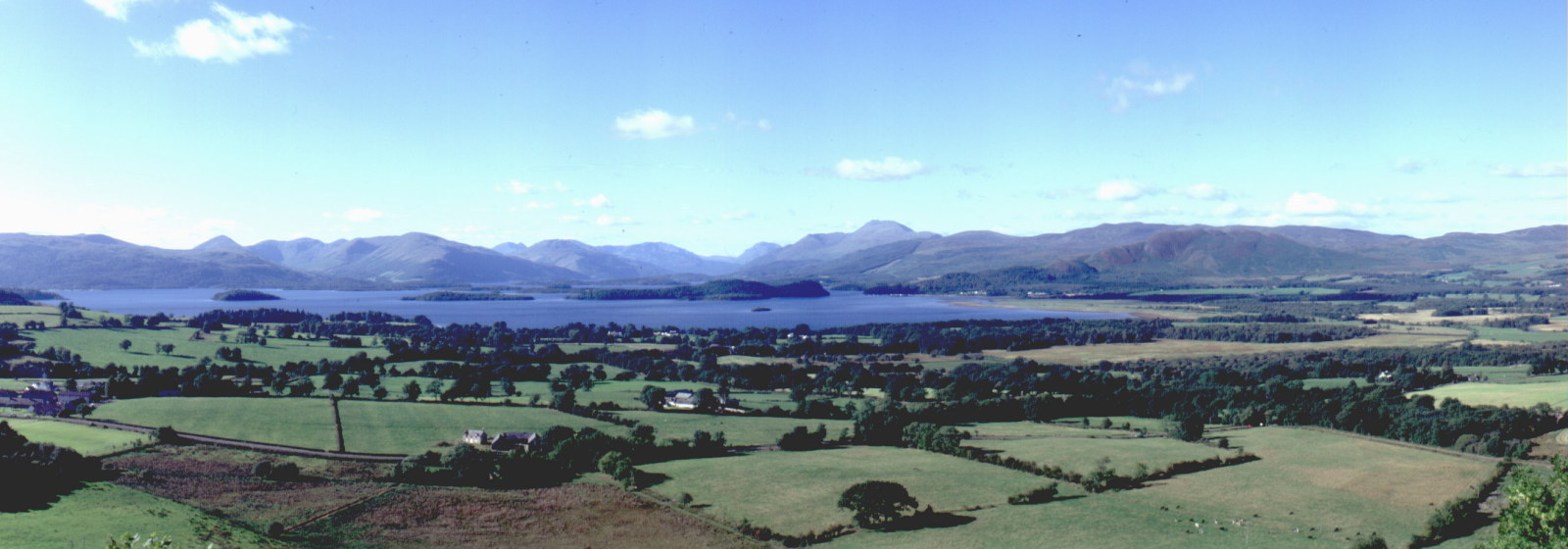 Loch Lomond looking north.The west bank home of Clan Colquhoun & Clan MacFarlane.The east bank the home of Clan Buchanan. You can purchase this 30 x 10 picture here! They suddenly seized all the boats which were upon the lake and probably with a view to some enterprise of their own, drew them overland to Inversnaid, in order to intercept the progress of a large body of west country whigs who were in arms for the government and moving in that direction. The whigs made an excursion for the recovery of the boats. Their forces consisted of volunteers from Paisley, Kilpatrick and elsewhere who with the assistance of a body of seamen, were towed up the river Leven in long boats belonging to the ships of war then lying in the Clyde. At Luss, they were joined by the forces of Sir Humphry Colquhoun, and James Grant, his son-in-law, with their followers, attired in the Highland dress of the period, which is picturesquely described. The whole party crossed to Craig Royston, but the Macgregors did not offer combat. If we were to believe the account of the expedition given by the historian Rae, they leaped onshore at Craig Royston with the utmost intrepidity, no enemy appearing to oppose them, and by the noise of their drums, which they beat incessantly, and the discharge of their artillery and small arms, terrified the Macgregors whom they appear never to have seen, out of their fastness and caused them to fly in a panic to the general camp of the Highlanders at Stathfillan. The low-countrymen succeeded in getting possession of the boats, at a great expenditure of noise and courage and little risk of danger. "After this temporary removal from his old haunts, Rob Roy was sent by the Earl of Mar to Aberdeen to raise it is believed a part of the clan Gregor, which settled in that country. These men were of his own family (the race of the Ciar Mohr). They were the descendants of about three humdred Macgregors whom the Earl of Moray, about the year 1624, transported from his estates in Monteith to oppose against his enemies the Mackintoshes, a race as hardy and restless as they were themselves. We have already stated that Rob Roy’s conduct during the insurrection of 1715 was very equivocal. His person and followers were in the Highland army, but his heart seems to have been with the Duke of Argyll’s. Yet the insurgents were constrained to trust to him as their only guide, when they marched from Perth towards Dunblane, with the view of crossing the Forth at what are called the Fords of Frew, and when they themselves said he could not be relied upon. "This movement to the westward, on the part of the insurgents, brought on the battle of Sheriffmuir; indecisive indeed in its immediate results, but of which the Duke of Argyll repaed the whole advantage". We have already given an account of Rob Roy's vacillating behaviour at this battle. "One of the Macphersons, names Alexander, one of Rob’s origional profession, videlicet a drover, but a man of great strength and spirit, was so incensed at the anactivity of his temprary leader, that he three off his plaid, drew his sword and called out to his clansmen, ‘Let us endurethis no longer! If he will not lead you, I will’. Rob Roy replied, with great coolness, ‘Were the question about driving Highland stots or kyloes, Sandie, I would yield to your superior skill; but as it respects the leading of men, I must be allowed to be the better judge’. ‘Did the matter respect driving Glen-Eigas stots’ answered Macpherson, ‘the question with Rob would not be, which was to be last, but which was to be foremost’, Incensed at this sarcasm, Macgregor drew his sword, and they would have fought upon the spot if their friends on both sides had not interfered. "Notwithstanding the sort of neutrality which Rob Roy had continued to observe during the progress of the rebellion, he did not escape some if its penalties. He was included in the act of attainder, and the house in Breadalbane, which was his place of retreat, was burned by General Lord Cadogan, when after the conclusion of the insurrection, he marched through the Highlands to disarm and punish the offending clans. But upon going to Inverary with about forty or fifty of his followers, Rob obtained favour, by an apparent surrender of their arms to Colonel Patricj Campbell of Finnah, who furnished them and their leader with protections under his hand. Being thus in a great measure secured from the resentment of government, Rob Roy established his residence at Graig Royston, near Loch Lommond, in the midst of his own kinsmen and lost no time in resuming his private quarrel with the Duke of Montrose. For this purpose, he soon got on foot as many men, and well armed too as he had yet commanded. He never stirred without a body guard of ten or twelve picked followers, and without much effort could increase them to fifty or sixty". For some years he continued to levy blackmail from those whose cattle and estates he protected, and although an English garrison was stationed at Inversnaid, near Aberfoyle, his activity addres and courage continually saved him from falling into their hands. The year of his death is uncertain, but it is supposed to have been after 1738. He died at an advanced age in his bed, in his own house at Balquhidder. When he found death approaching, "he expressed", says Sir Walter Scott, "some contrition for particular parts of his life. His wife laughed at these scruples of conscience and exhorted him to die like a man, as he had lived. In reply, he rebuked her for her violent passions, and the counsels she had given him. ‘You have put strife’ he said, ‘between me and best men of the country, and now you would place emnity between me and my God’. There is a tradition no way inconsistent with the former, if the character of Rob Roy be justly considered, that while on his deathbed he learned that a person with whom he was at enmity proposed to visit him. ‘Raise me from my bed’ said the invalid, ‘throw my plaid around me, and bring me my claymore, dirk and pistols; it shall never be said that a foeman saw Rob Roy Macgregor defenceless and unarmed’. His foeman, conjectured to be one of the Maclarens entered and paid his compliments, inquiring after the health of his formidable neighbour. Rob Roy maintained a cold haughty civility during their short conference, and as soon as he had left the house, ‘Now’ he said ‘all is over; let the piper plat Ha til mi tilidh’ (we return no more), and he is said to have expired before the dirge was finished". The grave of Macgregor, in the churchyard of Balquhidder, is distinguished by a rude tombstone, over which a sword is carved. Rob Roy had five sons – Coll, Ranald, James (called James Roy, after his father and James Mohr, or big James, from his height), Duncan and Robert, called Robert Oig or Young Robin. On the breaking out of the rebellion of 1745 the clan Gregor adhered to the cause of the Pretender. A Macgregor regiment, 300 strong, was raised by Robert Macgregor of Glencairnock, who was generally considered chief of the clan, which joined the price’s army. The branch of Ciar Mohr, however regarded William Macgregor Drummond of Bohaldie, then in France, as their head and a separate corps formed by them, commanded by Glengyle, and James Roy Macgregor, united themselves to the levies of the titular Duke of Perth, James assuming the name of Drummond, the duke’s family name, instead of that of Campbell. This corps was the relics of Rob Roy’s band, and with only twelve men of it, James Roy, who seems to have held the rank of captain or major, succeeded in surprising and burning, for the second time, the fort at Inversnaid, constructing for the express purpose of keeping the country of the Macgregors in order. At the battle of Prestonpans, the Duke of Perth’s men and the Macgregors composed the centre. Armed only with scythes, this party cut off the legs of the horses and severed it is said the bodies of their riders in twain. Captain James Roy at the commencement of the battle, received five wounds, but recovered from them and rejoined the price’s army with six companies. He was present at the battle of Culloden and after that defeat the clan Gregor returned in a body to their own country, when they dispersed. James Roy was attainted for high treason, but from some letters of his, published in Blackwood’s Magazine for December 1817, it appears that he had entered into some communication with the government, as he mentions having obtained a pass from the Lord Justice-clerk in 1747, which was a sufficient protection to him from the military. On James Roy’s arrival in France, he seems to have been in very poor circumstances, as he addressed a letter to Mr Edgar, secreatary to the Chevalier de St George, dates Boulogne-sur-Mer, May 22, 1753, craving assistance "for the support of a man who had always shown the strongest attachment to his majesty’s person and cause". To relieve his neccessities, James order his banker at Paris to pay Macgregor 300 livres. James Roy, availing himself of a permission he had received to return to Britain, made a journey to London and had an interview, according to his own statement, with Lord Holderson, secretary of state. The latter and the under secretary offered him, he says, a situation in the government service, which he rejected, as he avers his acceptance of it would have a disgrace to his birth, and would have rendered him a scourge to his country. On this he was ordered instantly to quit England. On his return to France, an information was lodged against him by Macdonnell of Lochgarry, before the high bailie of Dunkirk, accusing him of being a spy. In consequence, he was obliged to quit that town and proceed to Paris, with only thirteen livres in his pocket. In his last letter to his acknowledged chief, Macgregor of Bohaldie, dates Paris, 25th September 1754, he describes himself as being in a state of extreme destitution, and expresses his anxiety to obtain some employment as a breaker and breeder of horses, or as a hunter or fowler, "till better cast up". In a postscript he asks is chief to lend him his bagpipes, "to play some melacncholy tunes". He died abouit a week after writing this letter, it is supposed of absolute starvation. It was not till 1784 that the oppressive acts against the Macgregors which how for several years had fallen into desuetude, were rescinded by the British parliament, when they were allowed to resume their own name, and were restored to all the rights and priviliges of British citizens. A deed was immediately entered into, subscribed by 826 persons of the name of Macgregor, recognising John Murray of Lanrich, representative of the family of Glencarnock, as their chief, Murray being the name assumed under the Proscriptive act, by John Macgregor, who was chief in 1715. Although he secretly favoured the rebellion of that year, the latter took no active part in it; but Robert, the next chief, mortgaged his estate, to support the cause of the Stuarts, and he commanded that portion of the clan who acknowledged him as their head in the rebellion of 1745. Altogether, with the Ciar Mohr branch, the Macgregors could then muster 700 fighting men. To induce Glencarnock’s followers to lat down their arms, the Duke of Cumberland authorised Mr Gordon, at that time minister of Alva, in Stathspey, to treat with them, offering them the restoration of their name, and other favours, but the chief replied that they could not desert the cause. They chose rather to risk all, and die with the characters of honest men, that live in infamy, and disgrace their posterity. After the battle of Culloden, the chief was long confined in Edinburgh castle, and on his death in 1758, he was succeeded by his brother Evan, who held a commission in the 41st regiment, and served with distinction in Germany. His son, John Murray of Lanrick, was the chief acknowledged by the clan, on the restoration of their rights in 1784. He was a general in the East India Company’s service, and auditor-general in Bengal. Created a baronet of Great Britain 23rd July 1795, he resumed in 1822 the original surname of the family, Macgregor, by royal license. He died the same year. The chiefship, however, was disputed by the Glengyle family, to which Rob Roy belonged. Sir John Murray Macgregor’s only son, Sir Evan John Macgregor, second baronet, was born in January 1785. He was a major-general in the army, K.C.B. and G.C.H, and governor-general of the Windward Isles. He died at his seat of government, 14th June 1841. By his wife, Lady Elizabeth Murray, daughter of John, fourth Duke of Athole, he had five sons and four daughters. His eldest son, Sir John Athole Bannatyne Macgregor, third baronet, born 20th January 1810, was lieutenant-governor of the Virgin Islands, and died at Totola, his seat of government, 11th May 1851. He had four sons and two daughters. The eldest son, Sir Malcolm Murray Macgregor, fourth baronet, was born 29th August 1834, and styled of Macgregor, county Perth. Here is the geneology of William Mcgregor of Osian's glen or there abouts: William sr had three known sons William jr, and twins named Ezekiel and Willis. Ezekiel was born 1784 on Nov. 26 in Stanly co. North Carolina he married Sarah Ware her parents were Roland and Temperance Ware. Ezekiel begat 9 children there names were 1. Temperance (F) 2.Willis Nard (M) 3. Jason (M) 4. Jemima"Minnie" (F) 5. Wiley A. (M) 6. Avie (F) 7.Henderson(M) 8. Clinton (M) 9. Susan(F) Ezekiel died on 9/23/1856 in Warren co Tennesee. Willis Nard had 10 children Willis was born in 1812 died in 1859 his children were as follows 1. William Washington (M) 2. Audley Harrison (M) 3. Sarah Elizabeth (F) 4.Jemima (F) 5. George H. (M) 6. John, died of Pneumonia in the civil war 7. Mexico "Aunt Mac" (F) 8. Wiley Bud (M) 9. James Joseph James Clinton Pleasant Henderson "Coon" (M) 10. Rev. Newton Ezekiel |
Email:


